Skip to content

PRODUCT · FABRIC DOORS FOR LARGE OPENINGS

Fabric Vertical Lift Doors

Vertical lifting fabric doors for the widest openings we build: the leaf travels flat into the header, so the full structural opening stays clear and nothing sweeps the space in front of the door. Manufactured from PVC-coated technical fabric, with the leaf, the guide columns and the header loads calculated together with your building.

Maximum clear span
60.0 m
Maximum clear height
22.0 m
Opening speed
0.6 m/s
Wind load classification
EN 12424 up to class 5
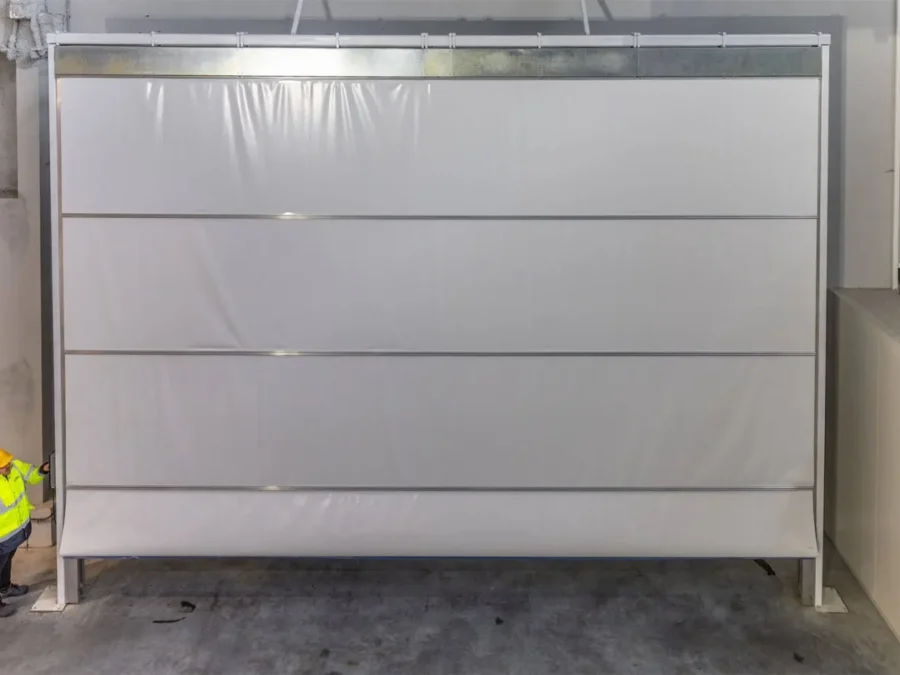
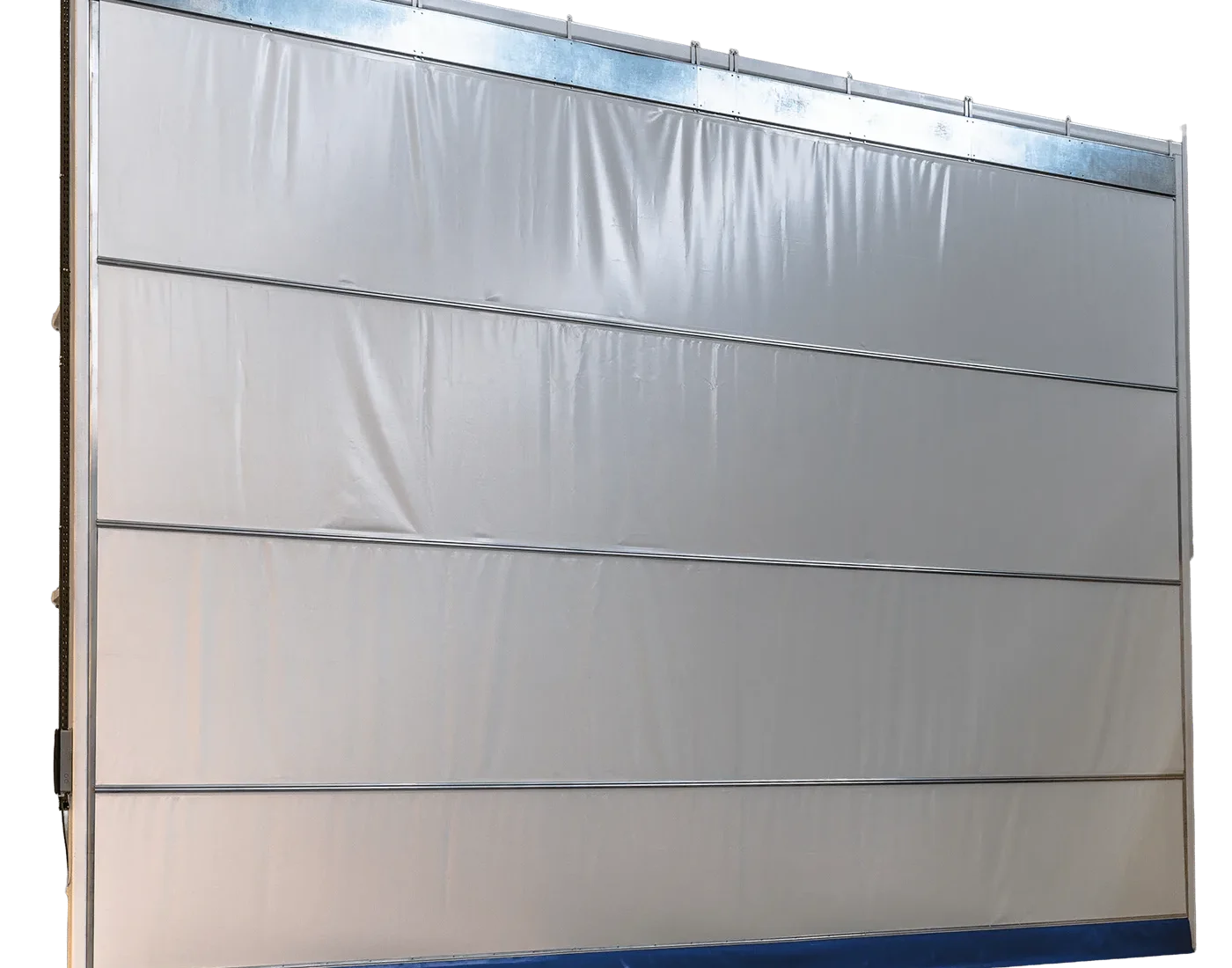
Skrzydło bramy podnoszonej z kolumną prowadzącą i niebieską uszczelką progową

IN FRAME Vertical lift leaf, guide column and header shown as delivered. The blue strip along the bottom edge is the sill seal — the only colour on the door, and it is real.

60 m MAXIMUM CLEAR SPAN
22 m MAXIMUM CLEAR HEIGHT
Class 5 EN 12424 · > 1 000 Pa
0.6 m/s OPENING SPEED
01

How a vertical lift fabric door works

In sequence, from fabric to building
01

The leaf is built as panels in a keder edge

PVC-coated technical fabric, welded into horizontal panels with an aluminium section at each joint and a continuous keder along both vertical edges. The keder is what holds the leaf in the guide — not the fabric itself.
02

The keder runs in the guide profile on nylon rollers

Each panel joint carries a roller that travels in the guide column. The load path is leaf → keder → roller → guide → column → building, and every step of it is calculated for the opening rather than taken from a table.

03

The drive lifts the leaf flat into the header

A shaft at the head takes the leaf up in one plane. Nothing folds outward, nothing swings into the building, and the full structural opening stays clear while the door is moving.

04

Wind locks engage as the leaf closes

Positive engagement between leaf and guide at intervals up the opening, so a gust cannot peel the fabric out of the rail. This is where the EN 12424 class is actually won.

05

The seal closes the perimeter, not just the sill

Head, jambs and sill are sealed as a perimeter. On a heated building the leaf is specified as part of the envelope, with the insulated variant where the heating bill justifies it.

02

Where vertical lift doors are specified

Each opening argues for itself

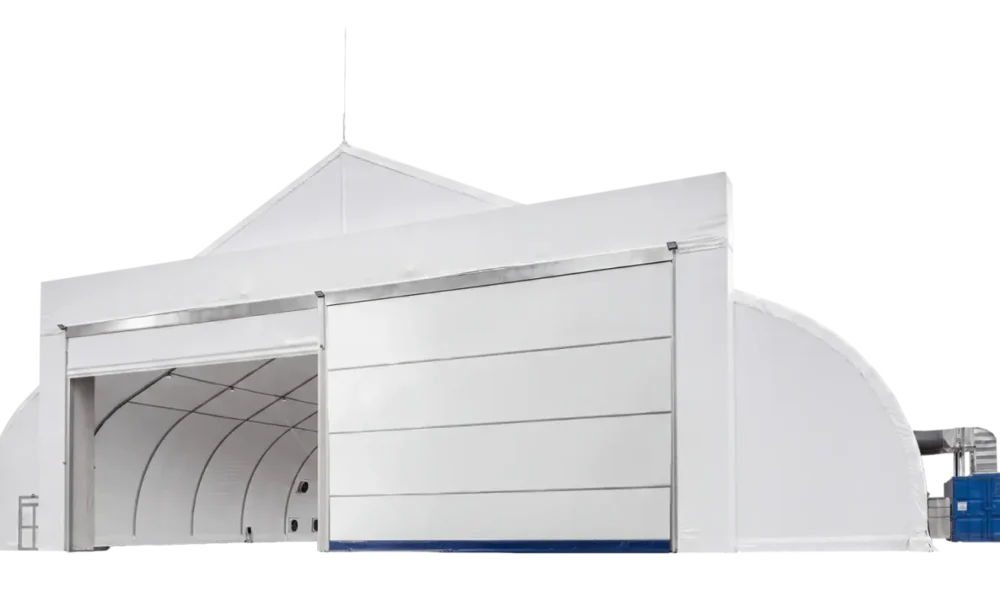
Aircraft hangar doors

Full clear width and height with nothing sweeping the apron, sized to the tallest tail in the fleet rather than to the structural opening. The default door family for hangar bays and the reason vertical lift dominates aviation.

Aircraft hangar doors →

Military and defence hangar doors

Air bases are cleared, flat and frequently coastal, so the governing wind class is usually the worst on the elevation. Calculated per building, documented for the tender, references anonymised.

Military & defence hangar doors →

Shipyard and dry dock doors

Openings sized for a hull section, in terrain category 0 with salt air on the fixings. Guide columns and fixings specified for the exposure rather than for the catalogue class.

Shipyard doors →

Craneway openings and heavy industry doors

Where a live crane rail crosses the opening, the vertical lift leaf clears the rail without losing hook height. Constant traffic, heat and dust are cycle-count questions, and they are answered in the drive selection.

Heavy industry doors →
03

Fold-up variants, and when to choose them instead

Two families, one calculation method

Fabric fold-up doors for low headroom

Where there is almost nothing above the lintel, the leaf folds into a compact stack instead of lifting flat — including openings beneath a live craneway. Headroom required 0.9 m. It is the retrofit answer when the building was never designed around a door.

Fold-up under a crane rail

The fold-up leaf clears a rail the vertical lift leaf would have to travel through. Hook height is unchanged and the rail is not modified — which is usually the difference between a possible project and an impossible one. Fabric fold-up doors →

The choice is geometry, not quality

Both families are flexible lifting doors built from the same PVC fabric, the same keder-and-roller load path and the same classification route.

Widest opening
Vertical lift
Least headroom above lintel
Fold-up
Fastest cycle
Vertical lift
Under a live craneway
Fold-up
Retrofit, building in service
Fold-up
Highest wind class
Either — calculated
Brama materiałowa otwarta na ścianie szczytowej hangaru, skrzydło złożone z boku
Fold-up leaf stacked to one side of a hangar end wall.
04

Specification

Dotted until the manufacturer’s technical data is confirmed
Specification
PropertyFabric vertical lift doorStatus
Maximum clear span60.0 mTO BE CONFIRMED
Maximum clear height22.0 mTO BE CONFIRMED
Opening speed0.6 m/sTO BE CONFIRMED
Wind load classificationEN 12424 up to class 5TO BE CONFIRMED
Product standardEN 13241TO BE CONFIRMED
Thermal transmittance, insulated leafU = 1.4 W/m²KTO BE CONFIRMED
Fabric weight0 000 g/m²TO BE CONFIRMED
Fabric typePVC-coated technical fabricCONFIRMED
Leaf colour optionsRAL range on requestCONFIRMED
Headroom required above lintel0 000 mmTO BE CONFIRMED
Cycles per day, standard drive00TO BE CONFIRMED
Retrofit into existing structureYes, subject to surveyCONFIRMED

Dotted values are placeholders awaiting the manufacturer’s technical data. Nothing in this table is a commitment until it appears in an offer for a specific opening — and no figure here has been rounded up to look better.

05

Controls and drive

What the operator actually touches

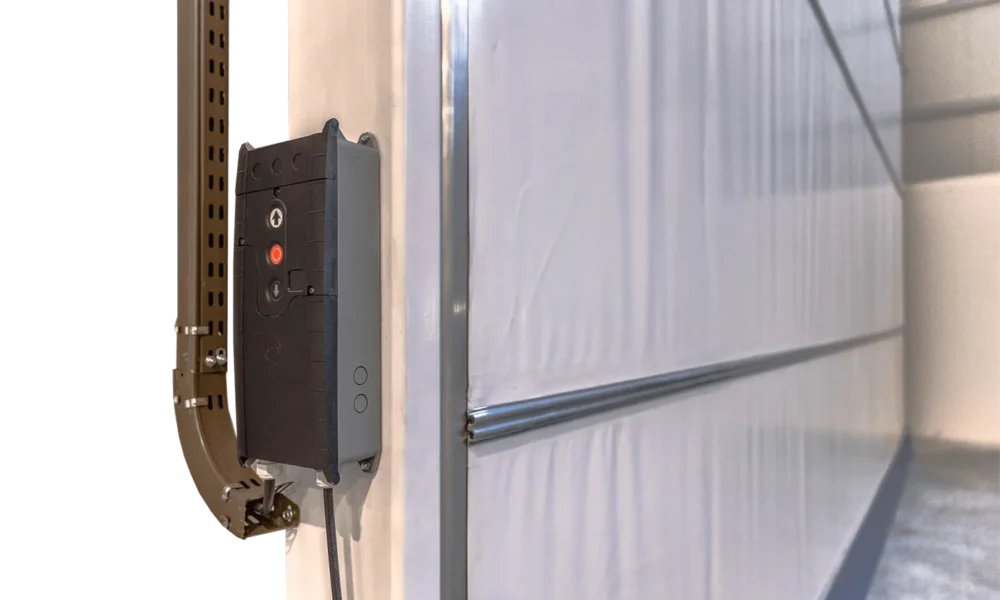
Three-button control at the opening as standard — open, stop, close — with the option of remote, loop, radar or card-reader release where the traffic pattern justifies it. The drive is selected against the cycle count you actually run, not the one in the brochure.

Standard control
Three-button, wall-mounted
Options
Remote · loop · radar · card reader
Manual override
Yes
Position on power loss
defined per project
Safety edge and photocells
EN 13241 compliant
Cycles per day, standard drive
00
Panel sterowania na ścianie obok skrzydła bramy materiałowej
Control panel at the jamb — open, stop, close, and nothing the operator has to be trained on.
06

Delivered with this door

Named on request, under NDA

The projects below are illustrative of the type of work we do, not released references. Every span, height and class is dotted because none of them is confirmed yet — real references, named or anonymised, replace them once the client releases them.

Brama materiałowa w hali przemysłowej, monter przy panelu sterowania CENTRAL EUROPE

Process plant, internal bay door

Vertical lift leaf inside a heated hall, specified for cycle count rather than for span. The fitter at the panel gives the scale.

SPAN 12.0 m HEIGHT 8.0 m CLASS 3 CLIENT NOT NAMED
Request the reference sheet →
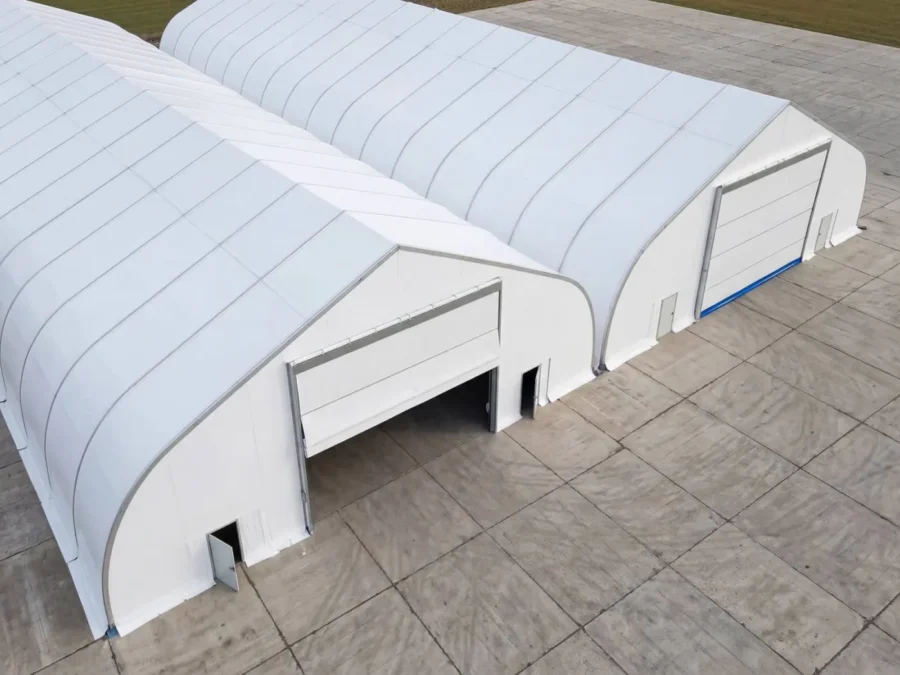
Dwa białe hangary łukowe z lotu ptaka, bramy podniesione NORTHERN EUROPE

Hangar bay, retrofit into an existing head

Installed into a hangar in service, with the guide columns fixed to the existing frame after survey and calculation of the reactions.

SPAN 18.0 m HEIGHT 9.5 m CLASS 4 CLIENT NOT NAMED
Request the reference sheet →
LOCATION WITHHELDPHOTO WITHHELD · restricted site — detail or drawing supplied in place of a site photograph

Air base maintenance hangar

Two vertical lift doors on a NATO-standard hangar. Client, site and photography under restriction.

SPAN 38.0 m HEIGHT 12.0 m CLASS 5 CLIENT NOT NAMED
Request the reference sheet →
07

Request a quote

Product is already set to fabric vertical lift. Give us the opening and the site and we come back with a class, a drive configuration and a price — usually within three working days.

PRODUCT · Fabric vertical lift door PRE-SELECTED ON THE FORM
  • 01 The clear opening — width and height.
  • 02 The site, so we can work out the wind class.
  • 03 The headroom above the lintel, which decides the door family.
Request a quote Read by an engineer, not a call centre.
DOCUMENTATION
Technical enquiries +48 00 000 00 00
Email technical@rekordaccess.com

Also tendered as: vertical lift fabric doors, PVC fabric doors, fabric hangar doors, flexible lifting doors. Same product, same classification route.