
Skip to content

SECTOR · SHIPYARDS, DRY DOCKS & MARINE FABRICATION

Shipyard Doors

Dry dock and fabrication hall openings sized to a hull section, standing in the worst wind exposure there is. Three things decide whether a shipyard door lasts: the terrain category it was calculated to, the corrosion specification of the parts that move, and whether the leaf seals well enough to be part of a containment envelope. We quote all three in writing.

Typical clear span, fabrication hall
30.0 – 60.0 m
Typical clear height
12.0 – 22.0 m
Terrain category, quayside
0 — open sea exposure
Governing wind class
EN 12424 class 5
Corrosivity category
C4 / C5-M to ISO 12944
PHOTO NEEDEDDry dock or fabrication hall, door in frame, vessel or crane for scale. Landscape, daylight, taken from far enough back that the opening reads against the hull.
PHOTO NEEDED · HERO

WHY THIS PANEL IS EMPTY This is the only one of our four sectors with no photography in the library. Until a frame exists the page leads with the argument rather than a substitute image from another sector — a hangar photograph here would be worse than an empty panel.

60 m MAXIMUM CLEAR SPAN
Class 5 EN 12424 · > 1 000 Pa
Cat 0 TERRAIN, QUAYSIDE
C5-M CORROSIVITY, ISO 12944
01

What makes a shipyard opening hard

Stated before it is answered
01

The opening is sized to the block, not the building

Fabrication halls are dimensioned around the largest section that will ever leave them, and that size changes with the order book. An opening specified to today’s block quietly caps what the yard can bid for.

02

Terrain category 0 — the worst wind case there is

A quayside hall stands in open-sea exposure with nothing upwind. This is the one sector where the highest EN 12424 class is the starting assumption rather than an upgrade, and where the guide-column reactions on the building are largest.

03

Salt air attacks the fixings, not the fabric

The leaf survives the marine atmosphere; the rails, rollers, fasteners and drive housing are what corrode. Specifying the fabric and leaving the ironmongery to the catalogue is how a door lasts five years instead of twenty.

04

Blasting, painting and containment

Where the hall does surface preparation, the door is part of the containment envelope: overspray, abrasive dust and extraction pressure all act on it, and a leaf that seals against the header is the difference between containment and a permit problem.

02

How the door answers it

Item by item, in the same order

Opening size

Clear spans to 60.0 m and heights to 22.0 m, with multi-leaf configurations where the elevation is wider than one leaf. Dimensioned against the largest block you intend to build, not the one on the floor today.

Fabric vertical lift doors →

Exposure

Terrain category 0 is calculated, never assumed: leaf, guides and header reactions are worked out together for the quayside, and the classification is issued with the calculation note. Governing class EN 12424 class 5.

How wind load is decided →

Corrosion

Guide profiles, rollers, fasteners and drive enclosure specified for the marine atmosphere with the corrosivity category stated in the offer — C4 / C5-M to ISO 12944, to be confirmed per project. The wear parts are the ones we name.

Talk to an engineer →

Containment

Full-perimeter seal at head, jambs and sill, with fabric selected for overspray and abrasive exposure. Where extraction runs at negative pressure, the leaf is specified against that pressure rather than to a nominal figure.

How the mechanism works →
03

Five questions to ask any shipyard door supplier

Including us

There are suppliers in this sector with better domain names than ours. None of that tells you whether the door on your quay was calculated for your quay. These are the five answers we would want in writing before signing anything — and they are the five we issue as a matter of course.

01

Which terrain category did you calculate the door to?

A quayside hall is category 0. If the answer is „class 5, standard”, nobody has calculated anything — the class is a test result, not a site assessment.

02

What are the reactions on my building at the guide columns?

The door hands a load to your structure. A supplier who cannot issue that figure has not sized the guides for your opening.

03

What corrosivity category are the fixings and rollers specified to?

Ask for the ISO 12944 category in writing. Fabric specifications are easy to quote; ironmongery specifications are where marine doors are won or lost.

04

Who manufactures the leaf, and who installs it?

On a quayside programme, three companies in the chain means three sets of dates. Ask whether the calculation, the manufacture and the crew are the same organisation.

05

What is the panel replacement and spares position in year seven?

Individual panel replacement, roller sets and seal lengths held to a schedule — or a whole new curtain. This is the number that decides cost of ownership, not the tender price.

04

Specifying a marine opening

Every unconfirmed value stays dotted

Dry dock doors and fabrication hall doors

The two openings behave differently. A dry dock door faces the water with no shelter and rarely cycles; a fabrication hall door cycles with the production programme and takes traffic on both sides. The same leaf family covers both, but the drive, the seal and the corrosion specification do not transfer between them.

Corrosion specification, in writing

Corrosivity category, coating system and fastener material stated per project: C4 / C5-M to ISO 12944, stainless fasteners, sealed roller bearings. Where a figure here is dotted we have not released it yet — the marine variant list is with our engineering department.

Naval yards and controlled sites

Naval work carries the same restrictions as an air base: vetted crews, escorted works, no site photography, references released under NDA. The defence documentation set applies here without modification.

Multi-leaf elevations

Where the elevation is wider than one leaf, the opening is closed by leaves working to a common control with a defined sequence — and the header is calculated for the case where one leaf is loaded and the other is not.

Maximum clear span
60.0 m
Maximum clear height
22.0 m
Wind load classification
EN 12424 class 5
Terrain category assumed
0 — open sea
Corrosivity category
C4 / C5-M
Product standard
EN 13241
Multi-leaf configurations
Yes, sequenced control
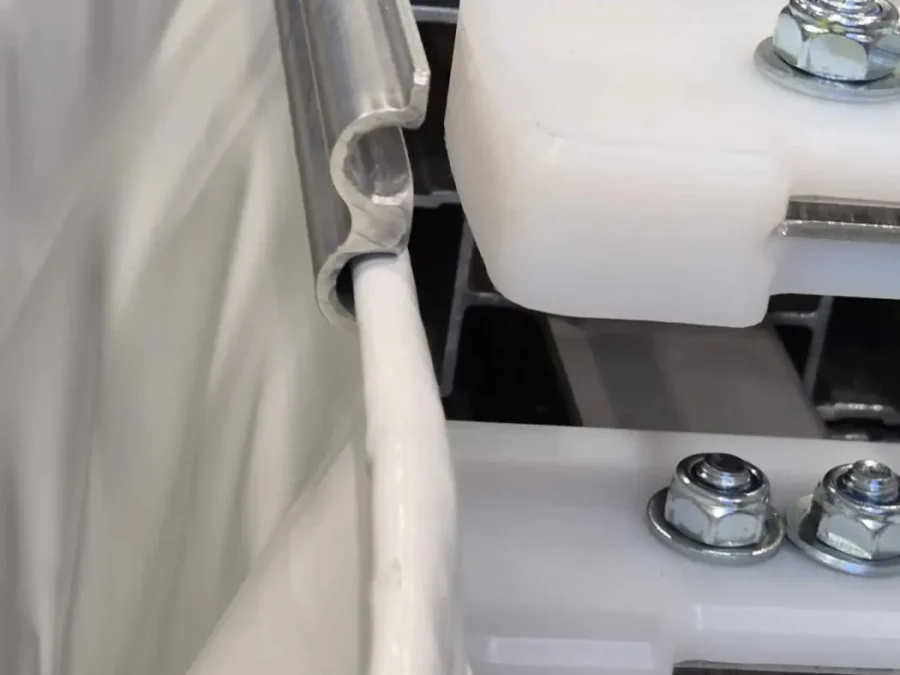
Profil nadproża bramy materiałowej w zbliżeniu
Head profile on a standard installation. In a marine atmosphere this joint, its fasteners and the roller behind it are the corrosion specification — not the fabric.
05

Delivered openings

Photography requested — captions are the request

The projects below are illustrative of the type of work we do, not released references. Every span, height and class is dotted because none of them is confirmed yet — real references, named or anonymised, replace them once the client releases them.

PHOTO GAPPHOTO NEEDED · dry dock or fabrication hall, door in frame, vessel or crane for scale

Fabrication hall, quayside site

Vertical lift door on a fully exposed quayside elevation, calculated together with the header structure of the building.

SPAN 46.0 m HEIGHT 15.2 m CLASS 5 CLIENT NOT NAMED
Request the reference sheet →
Prowadnica, keder i rolka nylonowa bramy materiałowej w zbliżeniu HARDWARE, GENERIC

Guide and roller specification

The load path and the corrosion path are the same components. Shown here on a standard installation — marine variants are specified per project.

ISO 12944 · TO BE CONFIRMED ROLLER SET SEALED BEARING NOT A PROJECT PHOTOGRAPH
Marine variant specification →
PHOTO GAPPHOTO NEEDED · installation in progress — crane, lift, fitters on site

Installation over a live quay

Lift plan and sequence written around dock traffic, with the yard working through the programme.

SPAN 32.0 m HEIGHT 12.0 m CLASS 5 CLIENT NOT NAMED
Request the reference sheet →
06

Request a quote

Sector is already set to marine. Send the opening and the quay, and we come back with the terrain category we have calculated to, the class, the corrosion specification and a price — usually within three working days.

SECTOR · Marine & shipyards PRE-SELECTED ON THE FORM
  • 01 The clear opening — width and height.
  • 02 The site, so we can work out the wind class.
  • 03 The headroom above the lintel, which decides the door family.
Request a quote Read by an engineer, not a call centre.
OR TALK TO AN ENGINEER
Marine enquiries +48 00 000 00 00
Email marine@rekordaccess.com

We have not photographed a shipyard installation for publication yet. Rather than show you a hangar and call it a dock, the panels on this page state what is missing.